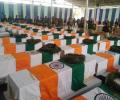
Pulwama must become the defining moment in our fight against terror, effecting a sea change in our mindset. The erratic, blow hot blow cold approach, the hallmark of our anti-terror-Pak-Kashmir policy must end. In its place is required a pragmatic, comprehensive, robust hard line course that is relentlessly pursued even in times of relative calm until the final objective is met, namely the eradication of separatism and the total annihilation of terror, says Vivek Gumaste.
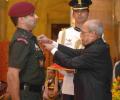
'India showcased its ability to launch multiple Special Forces strikes simultaneously across a well defended front.' 'Through these strikes Pakistan was given a glimpse of the full range of India's military capabilities,' says Brigadier Gurmeet Kanwal (retd).

Aziz Haniffa reports from Washignton, DC, on Foreign Secretary Sujatha Singh's three-day visit to the US capital.
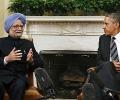
A federal body began a hearing on the impact of Indian trade policies on US businesses wherein American bodies and advocacy groups slammed India for its trade practices, alleging they hit their jobs and business.
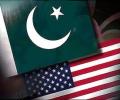
US Assistant Secretary of State for South and Central Asia Nisha Desai Biswal believes the India-US nuclear deal is not in limbo and it is for India and Pakistan to set the pace for conversations to resolve their issues. Rediff.com's Aziz Haniffa reports from Washington, DC.

'The world may be desirous of peace, but not Kim Jong-un.' 'Should we then accept the old adage that to maintain peace, we should be prepared for war?' asks Rajaram Panda.

Amid souring ties, the president visited Beijing for three days. On his return to India, a hope of better ties has arisen, says senior correspondent R Rajagopalan, who travelled with Pranab Mukherjee to the Asian superpower.

Indian-Americans can make a "significant difference" in helping first ever woman United States presidential candidate Hillary Clinton break the ultimate glass ceiling.

Prime Minister Narendra Modi's Nepal visit was an eye-opener for most Indians, as it appears as though the hard feelings of 17 years of neglect by Indian PMs has been overcome by this single, sincere visit, says Rajeev Srinivasan.

US Congresswoman Tulsi Gabbard, newly elected co-chair of the influential Congressional Caucus on India and Indian-Americans, discusses her vision for US-India ties with Rediff.com's Monali Sarkar.

'Modi's promise of change during the election campaign was on the domestic front, but his first year in office focused on foreign policy beyond all expectations,' says Ambassador T P Sreenivasan.

Prime Minister Narendra Modi will be reciprocating the reception he received from the Israeli PM during his visit last July, report Archis Mohan & PTI.
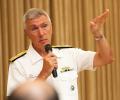
Admiral Samuel J Locklear III, Commander of the US Pacific Command, has not ruled out militants fighting in Afghanistan today switching their attention back to Kashmir post-US and NATO withdrawal of its troops from Afghanistan, and expressed concern over the recent terrorist attacks across the Line of Control that has exacerbated tensions between India and Pakistan.
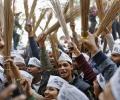
Even a 6 percent vote-share would make AAP an important player on the national scene. The key lies in strategically concentrating AAP's vote, especially in the cities, so that it can break Narendra Modi's momentum, besides defeating an already weak Congress, says Praful Bidwai.

Seeking deepening of ties with ASEAN, India on Saturday said it would soon draft a five-year plan of action starting 2016 to take the "trajectories" of common interests with the 10-member grouping to a new level and particularly emphasised on improving connectivity in the region to further boost trade and people-to-people contact.

Two US lawmakers write to the House Speaker asking to extend an invitation

Both Obama and Modi have taken bold steps towards laying the groundwork to give a big push to Indo-US trade, and now it's time to execute, says Bikash Mohapatra.

'It is in the interest of both sides that the visit of the US President is seen as being successful. Both sides have invested considerable political capital in it. This rapid exchange of visits and the decisions taken have to be justified, beyond the symbolism, which is no doubt important in itself. This opportunity to impart a fresh momentum to ties should not be missed,' says former foreign secretary Kanwal Sibal.

"We are committed to building a new India. We have to do this as early as possible," he said.

Excerpts from Prime Minister Narendra Modi's speech at the Combined Commanders Conference on board the INS Vikramaditya at sea, off the coast of Kochi.

'The surge of Saudi nationalism is the last thing Washington wants,' says Ambassador M K Bhadrakumar.

"The RSS is trying to change the nature of India. Other parties haven't tried to capture India's institutions," he said.

President Obama's coming visit to India has created quite a buzz, here is a look at all past visits of American Presidents to the country
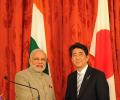
'Secretiveness and the element of surprise in announcing decisions marks the Modi style of diplomacy. From being a voluble politician, he became a reticent statesman... But the diplomatic dance is performed on thin ice and his adroitness is still to be proved,' says Ambassador T P Sreenivasan.
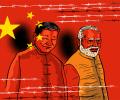
'As China rises and India grows to reclaim their earlier positions on the world stage as two of the largest economies and most important countries, there will indeed be some contention between these two powers.' 'There will also be plenty of space and room for cooperation amongst the two of us.' 'As our economic size increases to match the fact that we are the two most populous nations on earth, it will be all the more important for us to keep the interests of our peoples as well as those of the rest of the world in mind.' 'We shall have to grow together rather than as separate and disparate entities,' points out Ambassador Gautam Bambawale -- who served as India's ambassador to China -- in the 7th annual lecture of the Indian Association of Foreign Affairs Correspondents on March 1, 2019.
Two former senior United States diplomats, with more than 60 years experience in South Asia between them, have exhorted Washington to establish communication with Bharatiya Janata Party's prime ministerial candidate Narendra Modi sooner than later.

While China is bigger and feels mightier at the moment, Beijing's rulers would be well advised not to be tempted to provoke India, for that would only trigger a chain reaction around the world that would not serve anyone's interests, says Sanjaya Baru.

'Both Modi and Xi know that if all that there is to show for Modi's visit -- barely eight months after Xi's India trip -- is a repeat of the same old declarations, there will be a terrible sense of letdown in the public mood resulting in future summits losing credibility. Only the possibility of new ground being broken can justify Modi's trip at this time,' says B S Raghavan.

'Indira Gandhi proved herself a great war leader, but failed as a statesman,' says Colonel Anil A Athale (retd).

'Evacuating' Devyani's maid's family from India on T visas -- associated with severe sex or labour trafficking... The maximum number of persons thus evacuated by the US from foreign countries last year was from India... A thorough investigation of this is required at India's end,' says former foreign secretary Kanwal Sibal, 'with the US warned that such interference in India's judicial system will not be tolerated.'
.jpg)
Both India and China have demonstrated levels of maturity in diffusing tensions and ensuring that the border remains by and large incident free, says Seema Mustafa

'Diplomatic engagement will continue even as India keeps all its options open with respect to discretely targeting the Pakistani military and its terrorist proxies.'
'If India employed a strategy of a 'thousand cuts', Pakistan will wither away.'
'We need to be in a perpetual state of aggression, and able to swiftly change the goal posts to keep Pakistan in a state of imbalance,' argues Sanjeev Nayyar.
'India is part of our strategic and economic future,' says Richard Rahul Verma, the first Indian American to be appointed US Ambassador to India.

'This is going to be an opportunity to hear from the prime minister of the new India and the progress made in the last two years of the growing cooperation between the US and India in several areas, including areas that would have seemed implausible a few years ago.' US Congressman Ed Royce, who led the campaign to have Prime Minister Modi address a joint session of Congress, speaks to Aziz Haniffa/Rediff.com in an exclusive interview.

In anticipation of a verdict to be delivered by the International Tribunal of the Permanent Court of Arbitration in The Hague on Tuesday, China has orchestrated a worldwide campaign to defuse its findings.
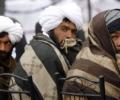
We should be prepared for a phase of increased tensions in India-Pakistan relationship thanks to the evolving situation in Afghanistan, says Shyam Saran.

Top security experts of India and the US met in New Delhi on Wednesday to discuss various measures, including exchange of technologies, to help each other face challenges like terrorism, cyber crime and ensuring safety of major cities.

'The book has immense value because it reveals the inner workings of the think-tank which appears to provide facts and insights to Modi, though he himself takes the final decisions and articulates them in his characteristic rhetorical style,' says Ambassador T P Sreenivasan.
 © 2026 Rediff.com - Advertise with us - Disclaimer - Privacy Policy - Sitemap - Feedback - About us - Terms of use - Grievances